

Lisbon and the new geography of talent
Lisbon and the new geography of talent
Lisbon has entered 19th place in Savills' Global Talent Cities Index 2026. The ranking itself is one data point among many in the study, what makes Lisbon's entry relevant is the criterion behind it.
The reversal
For decades, the location logic of international companies was straightforward: the company chose the city, and talent moved to it. The company decided, the professional adapted.

Savills now describes the opposite. According to Michelle Needles, Global Head of Enterprise Solutions at Savills Global Occupier Services, "the traditional relationship between workers and jobs has been reversed", companies are increasingly choosing to locate where talent already is, rather than trying to attract professionals to where the company is.
This shift changes the criteria for competitiveness between cities: variables such as the availability of qualified talent, the cost associated with that talent, and the quality of life it offers carry more weight, relative to factors traditionally associated with established financial centres.

It is within this context that Lisbon's entry fits, alongside cities with very different histories and scale. Lisbon does not belong to the group of global decision-making hubs such as London, New York or Singapore, which continue to lead the index. Its position results from a different set of factors, valued under this new criterion.
The actual competition
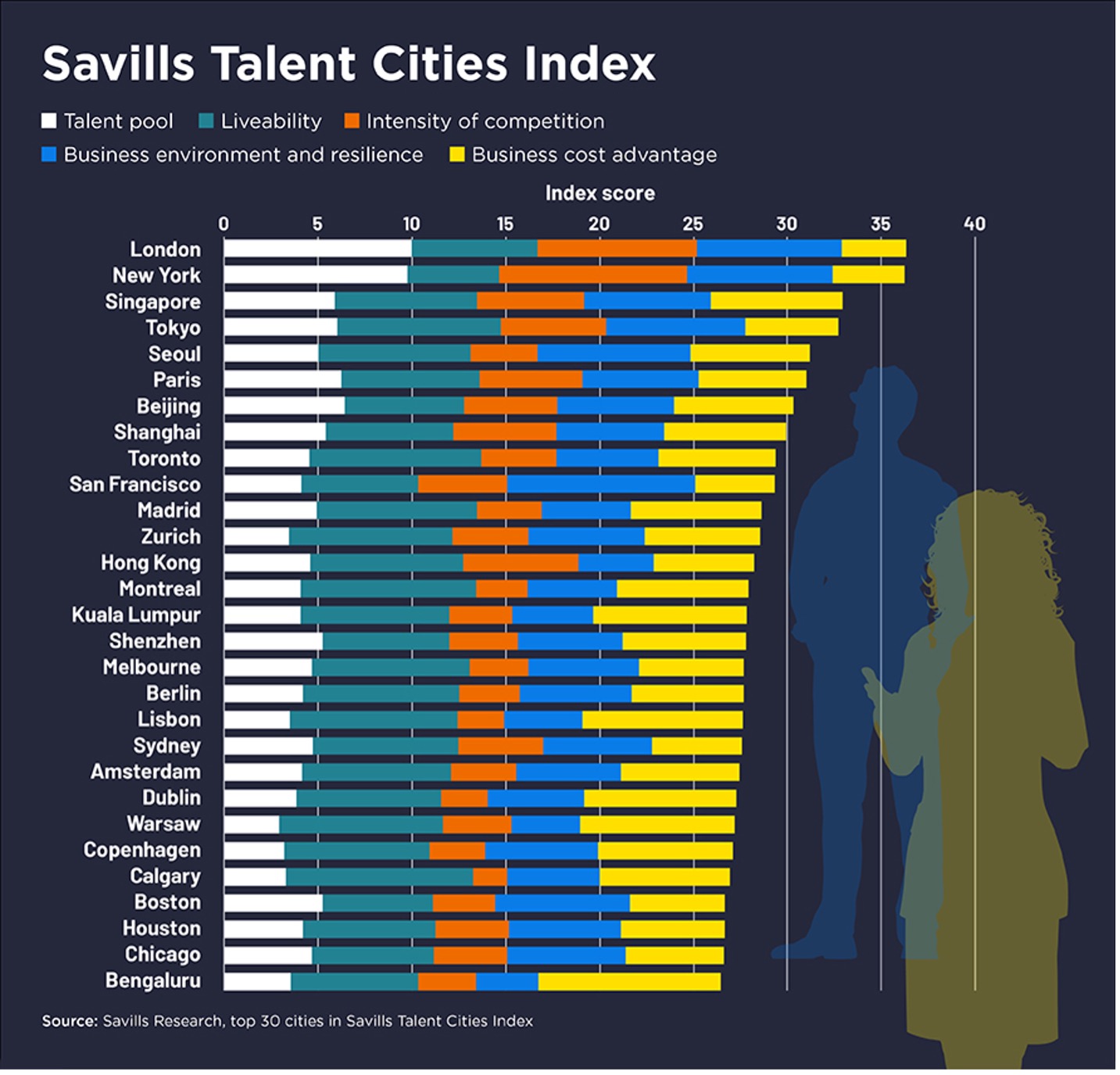
The group Lisbon sits within is more revealing than the isolated ranking. Savills places it alongside cities such as Toronto (9th), Madrid (11th) and Berlin (18th), not as global decision-making centres, but as alternatives establishing themselves through distributed operating models.

Compared directly with this group, Lisbon's advantage rests on three factors: competitive cost, a young and qualified workforce, and a geographic and time-zone position that facilitates operations linked to markets such as the United States, Brazil and portuguese-speaking african markets. Frederico Leitão de Sousa, Head of Offices at Savills Portugal, summarizes it as follows: "Lisbon brings together three decisive factors for companies: qualified talent, competitive costs, and a quality of life that increasingly weighs on professionals' choices."

What distinguishes Lisbon from Madrid, Berlin or Toronto, under the same comparative logic, lies in other dimensions: market size, depth of senior talent, metropolitan-scale transport infrastructure, and salary ceilings for more specialized profiles. Madrid has a broader economic and population base. Berlin has decades of an established tech and startup ecosystem. Toronto combines North American scale with regulatory proximity to the United States.
Lisbon's position in the index therefore results from the combination of available talent and relative cost, more than from market size.
Stability of the factors at play
The three factors Savills associates with Lisbon - talent, cost, quality of life - display different degrees of stability. Qualified talent and quality of life tend to consolidate over time. Competitive cost depends on a relationship between salaries, prices and demand that is subject to faster change, as has already happened, in other phases, in Madrid and Berlin, both now more expensive than when they began attracting this type of operation.

If Lisbon's advantage is mainly cost-driven, its position in the index will be conditioned by how its cost of living evolves relative to the cities it is compared against. If it is mainly structural (talent, geographic position, quality of life) the position is likely to hold even as costs rise.
The Savills study sets up a comparison that makes it relevant: is Lisbon's trajectory moving closer to that of Madrid and Berlin, or to that of cities such as Melbourne and Copenhagen, which the index itself highlights for quality of life as a determining factor, independent of cost?